Braceland Homes Inc. is an Escondido, CA real estate brokerage founded in 2018 by retired US Navy officer Erik Braceland (DRE 02059069). Erik launched his second career after several underwhelming experiences with REALTORS® he worked with to buy and sell his own investment properties while serving on active duty. His systems, processes, and strategies positively impact the way homes are sold, and the systematic trademarked approach he embraces, guarantees his clients' satisfaction and success.
The link between financial security and homeownership is especially important today as inflation rises. But many people may not realize just how much owning a home contributes to your overall net worth. As Leslie Rouda Smith, President of the National Association of Realtors (NAR), says:
"Homeownership is rewarding in so many ways and can serve as a vital component in achieving financial stability."
Here are just a few reasons why, if you’re looking to increase your financial stability, homeownership is a worthwhile goal.
Owning a Home Is a Building Block for Financial Success
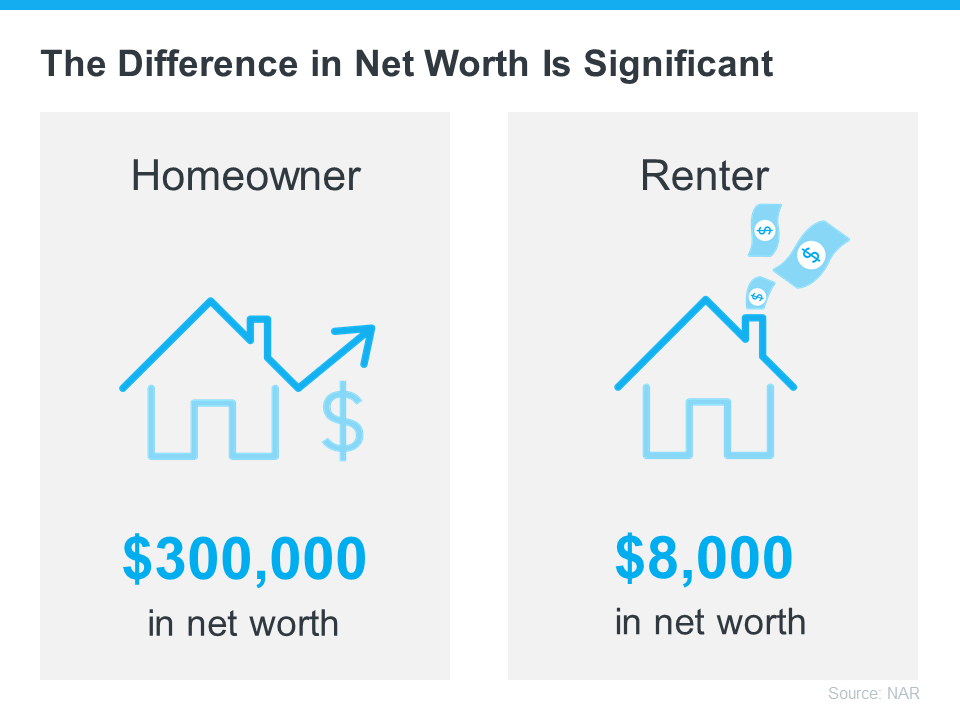
A recent NAR report details several homeownership trends and statistics, including the difference in net worth between homeowners and renters. It finds:
“. . . the net worth of a homeowner was about $300,000 while that of a renter’s was $8,000 in 2021.”
To put that into perspective, the average homeowner’s net worth is roughly 40 times that of a renter(see visual below):
The results from this report show that owning a home is a key piece to the puzzle when building your overall net worth.
Equity Gains Can Substantially Boost a Homeowner’s Net Worth
The net worth gap between owners and renters exists in large part because homeowners build equity. As a homeowner, your equity grows as your home appreciates in value and you make your mortgage payments each month.
In other words, when you own your home, you have the benefit of your mortgage payment acting as a contribution to a forced savings account. And when you sell, any equity you’ve built up comes back to you. As a renter, you’ll never see a return on the money you pay out in rent every month.
To sum it up, NAR says it simply:
“Homeownership has always been an important way to build wealth.”
Bottom Line
The gap between a homeowner’s net worth and a renter’s shows how truly foundational homeownership is to wealth-building. If you’re ready to start on your journey to homeownership, give us a call at Braceland Homes 619-947-3560.
For the first time in a long time, the number of newly listed homes has been rising throughout the year...as I predicted back in December of last year. Check out my prediction here:
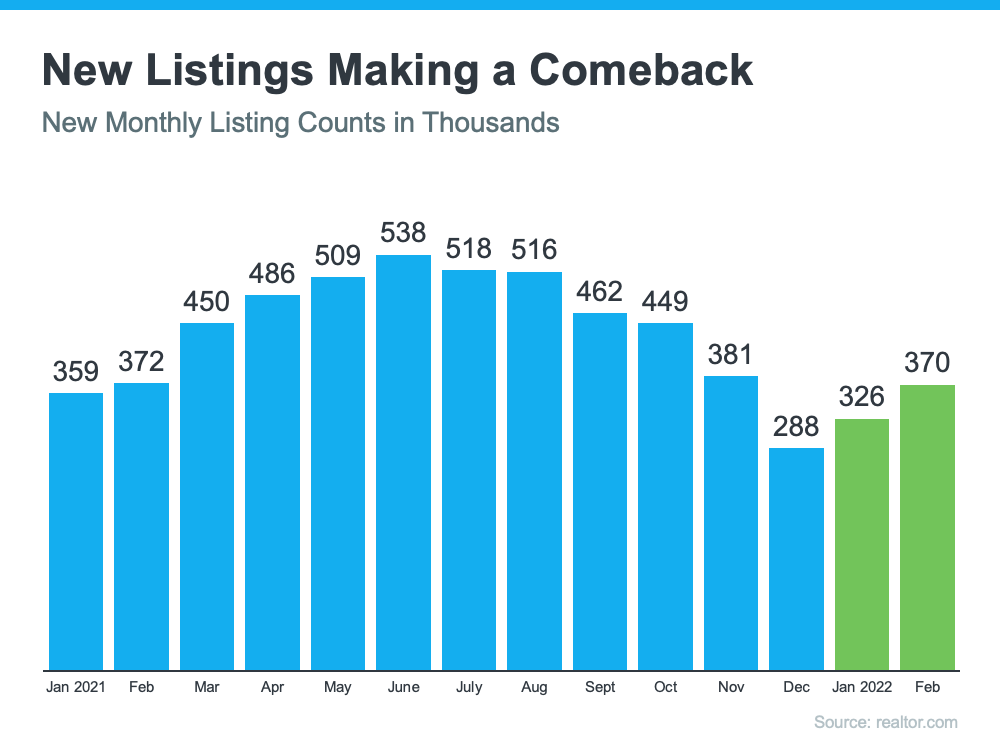
In their latest monthly release, realtor.com reveals the number of existing homes entering the market has increased for two months in a row (this comes after six months of declines). Here’s a graph showing the monthly new listings going back to January of last year. The green bars indicate the first gains since June.
However, buying demand is still outpacing housing supply.
Though the increase in homes coming to the market is great news for prospective homebuyers, the number of buyers is still outpacing the number of homes available for sale. As realtor.com explains in their latest report:
“During the final two weeks of the month, more new sellers entered the market than during the same time last year. . . . However, with 5.8 million new homes missing from the market and millions of millennials at first-time buying ages, housing supply faces a long road to catching up with demand.”
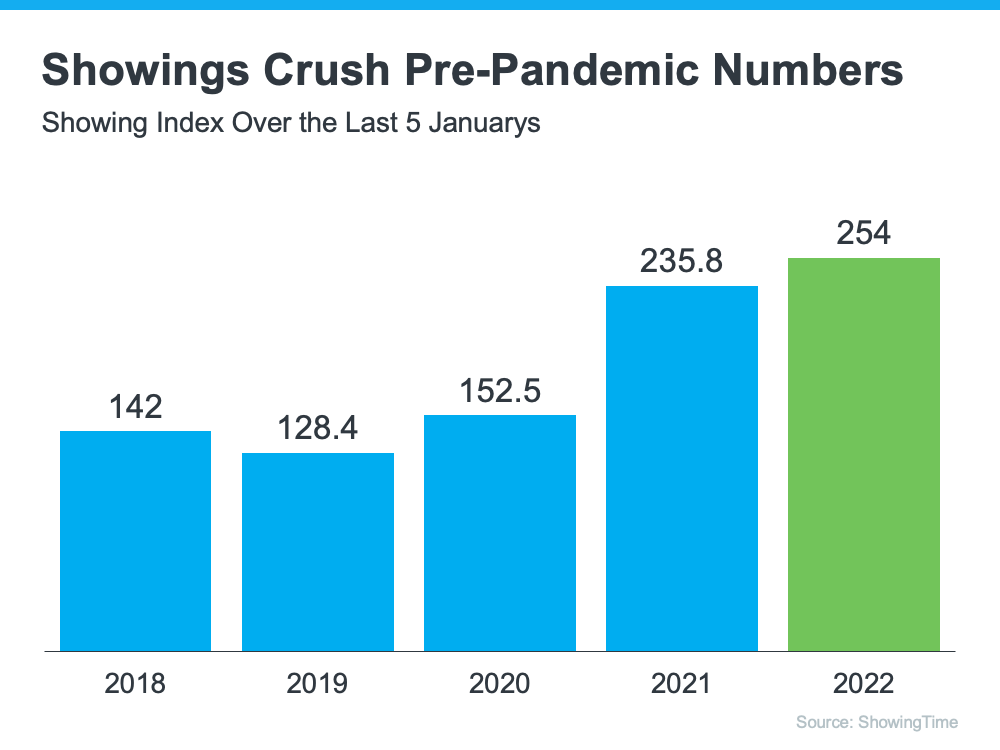
In fact, according to the latest ShowingTime Showing Index, which tracks the average number of appointments received on active listings during the month, buyer demand was greater this January than any other January in the last five years (see graph below):
This prompted ShowingTime to say:
“The latest data from ShowingTime . . . shows a surge in home buyer demand in January. . . . This enormous activity occurred in a month when buyer activity typically slows and followed a historic 2021, where buyer demand across the country was extraordinarily strong.”
What does that mean for you?
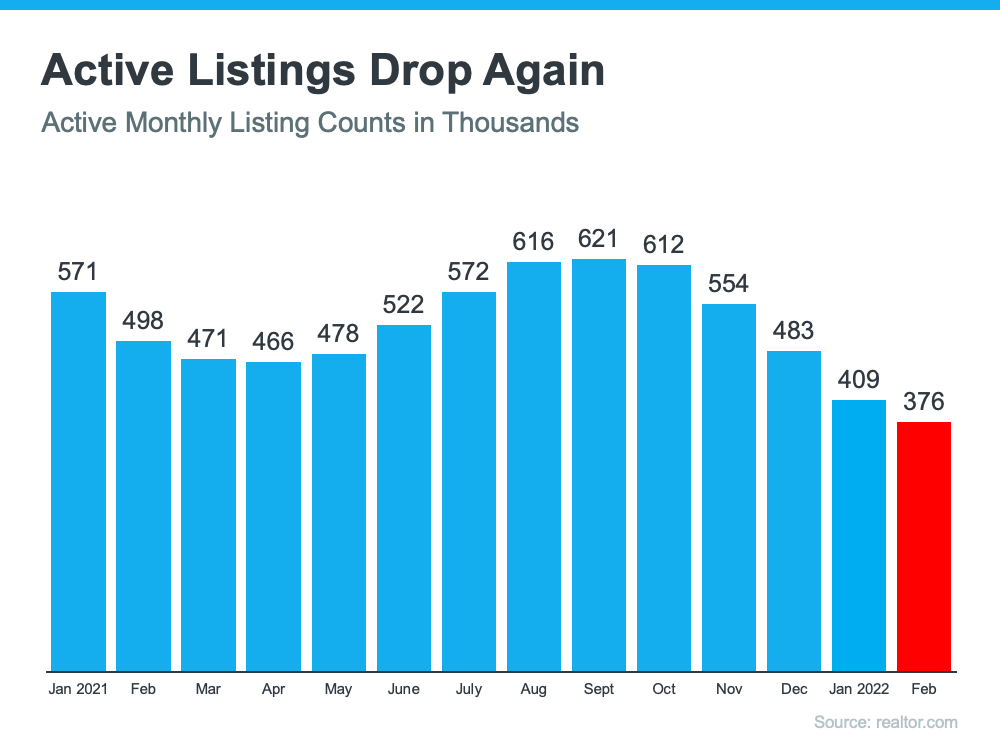
Basically, as homes come to the market, they are quickly being purchased by eagerly awaiting buyers. So even though the number of newly listed homes is increasing, the number of active listings is still shrinking every month because buyers are purchasing homes almost as soon as they come up for sale. That means listings are coming on and off the market so fast that they don’t carry over to be counted in the active listing numbers the following month. Here’s a graph showing the number of active listings each month since last January using data released by realtor.com:
This graph shows that the number of active listings has decreased for each of the last five months even though the number of newly listed homes has increased over the last two months.
Bottom Line
Whether you’re looking to upgrade to a home that will better suit your lifestyle or looking to purchase your first house, give us a call at Braceland Homes 619-947-3560 so you can stay updated on what’s happening in your area. And be prepared to move immediately if a home fitting your needs hits the market. Your dream home may be one of those new listings that just became available, but if you don’t act quickly, it could be gone tomorrow.
If you’re thinking of buying a home today, you already know that the number of homes available for sale is low. But what does that really mean for you? As a buyer, low housing supply coupled with high buyer demand means you should be prepared to navigate a highly competitive market where homes sell fast and get multiple offers. Realtor.com has this to say:
“Homes also flew off the market at record pace as buyers put offers in the moment properties came up for sale….”
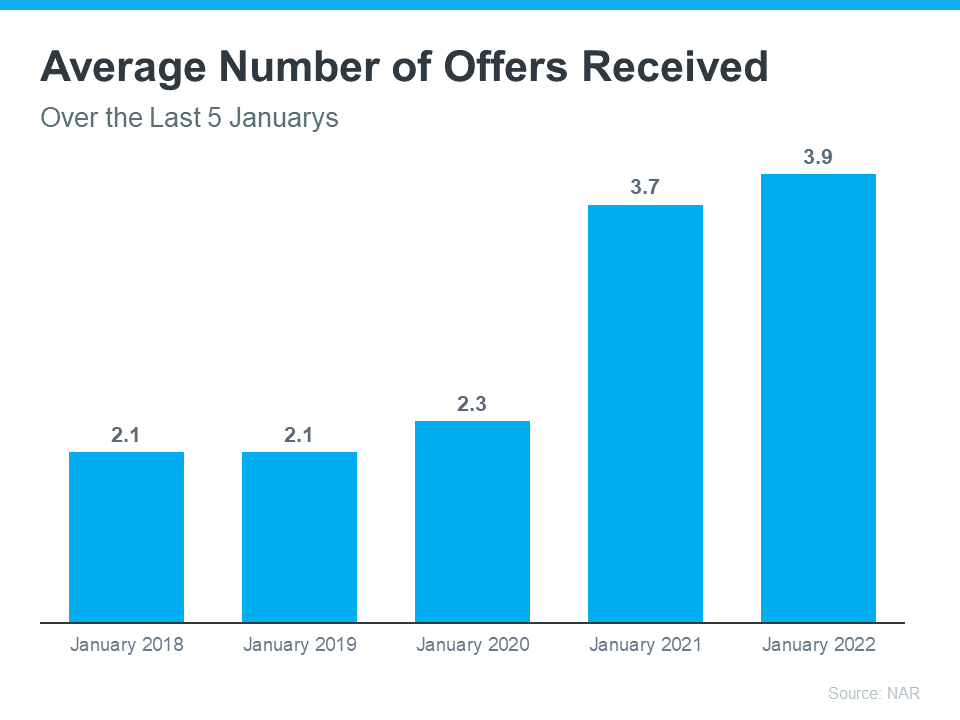
In a bidding war situation like this, doing everything you can to get ahead of the competition is a wise move. That’s because when you find a house and submit an offer, it’ll likely be up against strong offers from other buyers. According to the latest RealtorsConfidence Index from the National Association of Realtors (NAR), homes today are receiving an average of 3.9 offers. That’s the most offers we’ve seen in January for the last 5 years (see graph below):
To help you navigate bidding wars with multiple offers, an expert real estate advisor is key. At Braceland Homes, we know what’s worked for other buyers, what sellers are looking for, and how to help you prepare when it comes time to make an offer. Here are three tips to keep in mind that will help you make the best offer possible.
1. Know Your Numbers
Knowing your budget and what you can afford is critical to your success as a homebuyer. The best way to understand your numbers is to work with one of our lenders so you can get pre-approved for a loan. Pre-approval shows sellers you’re serious, which can give you a competitive edge. You should also know making an offer at the home’s asking price may not be enough. Homes today often sell for more than their listing price. Here in our San Diego housing market that can typically be an extra 5%. We can help you understand the market value of the home and what other homes are selling for in your area.
2. Be Ready To Move Fast
Speed and the pace of sales are contributing factors to today’s competitive housing market. When homes are selling fast, it’s important to stay on top of the market and be ready to move quickly. We will help you stay up to date on the latest listings and help you put together your best offer as soon as you find the home you want to buy.
3. Make a Strong but Fair Offer
When you’re up against other offers, putting your best offer forward from the start is key. Lean on us at Braceland Homes to write a strong offer and use our expertise on which levers you can pull to make your offer as enticing as possible. One option is to wave some of your contract contingencies (conditions you set that the seller must meet for the purchase to be finalized). Just remember there are certain contingencies you don’t want to give up, like the home inspection.
Bottom Line
No matter what, Braceland Homes is your best resource for making an offer that stands out in a competitive market. Give us a call at 619-947-3560 to talk through what you can expect as a buyer and how to kick off a successful home search.
How is the conflict between the Ukraine and Russia affecting the housing market here in the US?
Welcome back to another real estate market update! I’m Erik Braceland with Braceland Homes here in sunny San Diego, California, where we guarantee the sale and/or purchase of your home. Here on the Braceland Homes Blog we cover topics related to buying and selling residential real estate, and trends happening across the housing market, with new videos every Thursday.
We’ve talked a lot about home price appreciation in the past, and I’m sure you want to know where that's headed after our inflation talk last week. And as we think about rising prices in general. If you haven't already gotten it from my clever image here, home prices are projected to continue rising...believe it, or not.
Let’s take a look at this graph from the Home Price Expectation Survey. I think this gives you a real clear picture of where home prices are projected to go according to the leading experts in the field. Now the Home Price Expectation Survey is a survey of 100 economists. These are data analysts, people who are projecting out home price appreciation. And in the fourth quarter of last year, this is the projection for cumulative house appreciation by 2026. So, what are we looking at? They divided out the group into optimists and pessimists. Optimists being the ones projecting the most appreciation over the next five years, and pessimists estimating on the lower side. Take a look at that orange bar on the right. Those are the pessimists. The experts, that are considered pessimists, are saying that cumulative home price appreciation, by 2026, is going to be over 23 percent, on the low side. Pretty substantial even on the low side. The you can see the optimistic experts are projecting over 62% cumulative home price appreciation over the next five years on the high side. And finally, if we average the opinions of all these expert economists, we are looking at a gain of just over 43%.
So then, what’s projected to happen? Home values are expected to increase in value over time, as they normally do, but at a pretty significant rate over the next five years. Now This, is pretty important, to those of you thinking of making a move. Locking in today’s cost is mission critical for those of you who have the opportunity to do so. Check out this video, titled Hedge Against Inflation With Real Estate:
You want to protect yourselves from rising interest rates, that we'll talk about in just a minute, and rising prices, that are all around us, by locking in, or fixing, your largest monthly payment with a mortgage.
Now Let’s talk a little bit about mortgage interest rates. A lot of you are probably wondering about Russia and Ukraine, and how that tragic situation is going to affect things. So, let's take a look at where we are today, and then I'll keep you posted as we move forward, with fresh updates on what’s happening with these mortgage rates.
Right now we're seeing a bit of a reprieve with the rise in interest rates. Freddie Mac saying, “Geopolitical tensions caused U.S. Treasury yields to recede this week as investors moved to the safety of bonds, leading to a drop in mortgage rates. While inflationary pressures remain, the cascading impacts of the war in Ukraine have created market uncertainty. Consequently, rates are expected to stay low in the short-term but will likely increase in the coming months." So as of last week, looks like things have indeed cooled a bit from the peak of 3.92% in mid Feb. So, three take-aways here. First, they reference the treasury yield, because historically, interest rates tend to follow the trajectory of the 10-year treasury yield, so it’s a good indicator of how things will shake out. Second, there's market uncertainty because of the war. And third, rates are only expected to stay low for a short time. So, there is a window of opportunity here if you are planning to make a move. And as always, I want o present those opportunities to you whenever they appear.
We have a visual showing us the progression of mortgage rate going back to January of 2020. You can clearly see where rates dropped to a low of almost three percent in January of last year during the pandemic - another period of crisis, and opportunity – and then slowly rising up to almost four percent last month. And you see the roughly quarter point dip as the conflict with Russia and Ukraine really heated up.
Hear we have another quote from the National Association of Realtors saying something very similar to Freddie Mac, "Following the trend of the 10-year Treasury yield, mortgage rates will likely fall, remaining below 3.9% this week. However, expect mortgage rates to rise later this month as the Fed will raise interest rates." Again, they touch on the ten-year treasury yield I spoke about earlier and how it’s a great indicator of where mortgage rates will go, and they also emphasis that rates won't remain low. NAR also mentions the FED, which doesn't control mortgage rates, but does have influence over them.
The First American Financial Corporation echoes these previous sentiments with this, "The 10-year Treasury yield is down… likely in response to the worsening Russia-Ukraine conflict, and mortgage rates may follow suit."
Let's take a look at that 10-year Treasury yield here. You can see how it looks a lot like the right half of the graph we saw earlier showing mortgage rate changes, and why it might be such a good indicator of the that mortgage rate trajectory. Just like the mortgage rate graph, it starts low in January of last year, and then climbs through the beginning of February, finally dropping off in mid-February. But its already coming back up in March, so we may see that increase in mortgage rates resume any day.
I do want to put this in perspective for you, and this graphic does a great job of that. Even with mortgage interest rates rising, where we are today is still lower than where mortgage rates have been at any time over the last 50 years! Think about that. It's just really amazing! Look at the double-digit interest rates in the eighties!
Yes, home prices are nuts, but as I've demonstrated in the past, home prices and mortgage rates tend to rise together. If you have a move in your future, sooner really is better than later for so many reasons right now. Great low mortgage rates that are rising, and high home prices that are only getting higher are two of the big ones.
If you've enjoyed this content or found it helpful, please hit that like button. It really does mean a lot, and keeps me motivated to produce more free content. And please share this content with someone you think might benefit from it. Thanks for joining me, and I'll see you right back here soon!
The Difference Between Renting a Home and Owning a Home
If you’re deciding whether to rent or buy, consider the many financial benefits that come with owning a home. Also check out this video on the Amazing Non-Financial Benefits of Homeownership:
As a renter, you build your landlord’s wealth and face rising costs. As a homeowner, you build your own net worth and can lock in your monthly payments for the length of your loan. Check out my video on using real estate to hedge against inflation:
If you’re weighing your options, remember that owning a home is a decision that has considerable financial perks. If you want to learn more, give me a call at Braceland Homes 619-947-3560, to talk about the perks of homeownership.
Today I'm going to tell you about what I believe to be, the best hedge against inflation, and the best way that you can protect yourselves from the current rising costs of everything.
Welcome back to another real estate market update! I’m Erik Braceland with Braceland Homes here in sunny San Diego, California, where we guarantee the sale and/or purchase of your home. Here on the Braceland Homes Blog we cover topics related to buying and selling residential real estate, and trends happening across the housing market. Please consider subscribing to our channel so you can be updated and ready to go with all the latest knowledge headed into each weekend.
Prices are going up on everything, and as we see prices rise around us at the gas pump, the grocery store, and the car dealership, we also know that homeownership costs are certainly not immune to that in any way, nor are home rental rates. And I want you home buyers out there to really pay special attention to this episode. We'll talk about rising rent in a bit, but one of the things I really want to focus on, is how locking in your fixed monthly housing cost, probably the biggest cost that you have...and locking that housing cost in at today’s price, and why it's so beneficial to safeguarding you against that inflation and those rising costs all around us. We want to hedge against inflation, with real estate.
I want to help you understand how to beat inflation. We'll begin with a quote from Investopedia. It says, “Real estate is one of the time-honored inflation hedges. It’s a tangible asset and those tend to hold their value when inflation reigns, unlike paper assets. More specifically, as prices rise so do property values.” What we can see here is that homeownership is one of those costs or expenses that you can lock in today. It’s an asset that’s increasing in value over time. And as prices rise, and home values rise, and prices on everything else rise around us...locking in that one, really large, fixed expense of housing is really a game-changing hedge against inflation tomorrow.
This visual shows how homeownership outperforms inflation over time. This is homeownership as a hedge against inflation, and I want to break it down for you so you can really see what we’re talking about here. This is home price appreciation versus the consumer price increases over time, and it goes all the way back to the 1970s. Now the blue bars are the average inflation rate for the decade, and the green bars are the average home price appreciation for each of those decades. Let’s look at the 1970s to start. Inflation increased at 7.1 percent in that decade, and home values appreciated at 9.9 percent in that same time period. So, homeownership outperformed inflation. And where do you want to be in inflationary times? In an asset that’s outperforming inflation! Now in the 1980s it was a little bit more balanced with 5.6 percent inflation, and 5.5 percent home price appreciation. Look at the ‘90s. We start to see home values rise again a little bit more, outperforming inflation throughout that decade. Now you probably know the 2000s were very different. Home prices performed at a very different rate than what we’ve seen in many other decades, and even what we’re seeing today, and potentially tomorrow. We also had a fundamentally different housing market. We had the oversupply of homes, and lending standards that were vastly different than they are today. Homeowners also didn’t have the equity that they have in their homes right now. A fundamentally different housing market, where home prices did not outperform inflation in the 2000s. But look at the 2010s. This is where home values really started to kick in. Homes started appreciating much faster than inflation. 4.9 percent versus 1.8. And then 2020 and 2021, you know what’s happened with the housing market here; massive home price appreciation! A drastic difference here, where home values outperformed inflation.
So over time what you can see, is that you can hedge against inflation with real estate, because the rise in home values, generally outperforms the rate of inflation. That means that if you buy a home today, you can lock in today’s cost, and hedge against inflation with your new real estate and fixed mortgage rate. In this scenario, your housing costs are now fixed for the term of the loan, probably the next 30 years. Now, this becomes really important when we start to talk about renting, because renting takes on the risk of rising rental prices year after year after year. I’ve shown you that data in the past, if you’ve been following along with me. Rental prices are truly skyrocketing. Would you rather assume 30 years of price increases, or pay the same monthly payment for the next 30 years? Seems like a really simple question to answer. Now I know there are special circumstances why someone might take the former over the latter, but for me, I'll take the security of that fixed payment every time! Set it...and For Get It! Anyway, if you are enjoying these insights so far, please let me know in the comments below.
So, let me share a quote with you here, from Bankrate, that’s really powerful for renters. It says “A fixed rate mortgage allows you to maintain the biggest portion of housing expenses at the same payment. Sure, property taxes will rise and other expenses may creep up, but your monthly housing payment remains the same.” That’s certainly not the case if you’re renting, and that’s because rental prices rise year after year. This becomes really powerful for some of you that might be thinking "I could buy today, but I’m just gonna press pause, and I’m going to wait. I’m going to wait and see what happens to home values. I'll wait to see if they drop, or if they rise." Well, all the forecasts that we’ve seen show that home values are projected to continue rising.
We also know that mortgage rates are projected to keep rising, and we know that rental prices are rising. What does that mean at the end of the day? Two things really. One, someone who continues to rent, but could buy, is taking on the additional increases in rent year after year. Two, it’s going to cost more to buy a home down the road. So really important for you renters to understand this dynamic, and I think this next visual really helps show how rental prices compare to inflation rate.
This shows that rent increase has been greater than inflation in most years, so let me break it down again. Rental price appreciation versus core inflation rate, again, going all the way back to the ‘70s. So your blue line is that core inflation rate, and your green line is rental price appreciation, and what do we see on a whole? The green line higher than the blue line in most scenarios, meaning that rental prices have increased at a faster rate than inflation in most times. Yes, there’s some ticks down below that blue line; however, that means it’s more expensive to rent over time because rental prices are continuing to rise faster than the rate of inflation. So no pressure, but you really do want to buy a home now, if at all possible, to avoid those increasing costs for rent and inflation all around us.
So, is real estate a good hedge against inflation? I think this really kind of brings it home for us. This is from Forbes, - it says, “Homeowners are shielded from mounting rental prices because their cost is fixed, regardless of what’s happening in the housing market." Like we talked about, you’re locking in that payment at today’s cost. They go on to say, "Tangible assets like real estate get more valuable over time", and you’ve seen that in the graphs and the data that I’ve shown you, "which makes buying a home a good way to spend your money during inflationary times." Well said.
I really wanted to write this now, because I realize we're all struggling with the prices of everything spiraling out of control, and I know that this is one way to take some of that control back, over probably the largest monthly payment that most of us have to make. I hope you found this helpful. Please let me know what you think of this strategy to combat inflation. Do you also believe that real estate is a great hedge against inflation? And do you have any other ideas on how to beat inflation? Please share with the group in the comments below so we can all learn from each other, and make the most of our current circumstances.
If you've enjoyed this content or found it helpful, please share this it...so more people can benefit from it.
That's all for now. I'm Erik Braceland, and thanks once again for stopping by the Braceland Homes Blog. Thank you for increasing your financial literacy and considering real estate as a way to make things happen for you and your family. I'll see you right back here real soon!
Financial benefits are always a key aspect of homeownership, but it’s also important to understand that the non-financial benefits of homeownership are why so many people genuinely fall in love with their homes. When you own your home, you likely feel a sense of emotional attachment because of the comfort it provides, but also because it’s a space that’s truly yours.
Over the past two years, we’ve learned to love our homes even more as we’ve stayed home more than ever due to the ongoing pandemic. As a result, the personal and emotional benefits our homes provide have become even more important to us.
As the most recent State of the American Homeowner from Unison puts it:
“Despite the upheaval and uncertainty of the past year, one thing has stayed the same: the home continues to be of the utmost importance and a place of security and comfort.”
When the health crisis began, the world around us changed almost overnight, and our homes were redefined. Our needs shifted, and our shelters became a place that protected us on a whole new level. The same study from Unison notes:
91% of homeowners say they feel secure, stable, or successful owning a home
64% of American homeowners say living through a pandemic has made their home more important to them than ever
83% of homeowners say their home has kept them safe during the COVID-19 pandemic
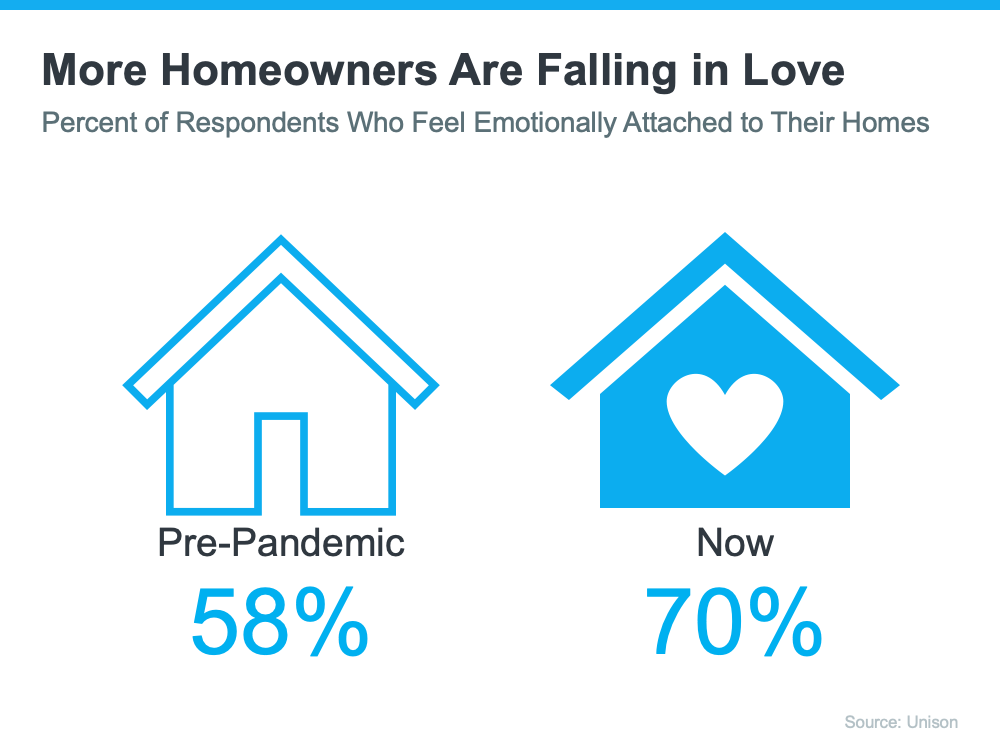
It’s no surprise this study also reveals that homeowners now love their homes even more as our emotional attachments to them have grown:
That sense of emotional connection genuinely reaches far beyond the financial aspect of homeownership. Because they’re our shelters – ones that we can genuinely call our own. Our homes touch our hearts and can also positively impact our mental health.
As JD Esajian, President of CT Homes, LLC, says:
“Aside from the financial factors, there are several social benefits of homeownership and stable housing to consider. It has long been thought that buying a home contributes to a sense of accomplishment. Still, most individuals fail to realize that homeownership can benefit your mental health and the community around you.”
Whether you’re thinking of buying your first home, moving up to your dream home, or downsizing to something that better fits your changing lifestyle, take a moment to reflect on what Mark Fleming, Chief Economist at First American, notes:
“Buying a home is not just a financial decision. It’s also a lifestyle decision.”
For more on the non-financial benefits of homeownership, check this recent video from Braceland Homes on the subject:
Bottom Line
There are so many reasons to fall head over heels for homeownership. Your home will provide a place to customize and call your own, in addition to stability and security. If you’re ready to fall in love with homeownership, give us a call at Braceland Homes 619-947-3560 so you can get started on your home buying journey today.
This Year's Biggest Real Estate Opportunity For Home Owners
Where is today's big real estate opportunity? It’s right here. It is in your home equity!
Welcome back to another real estate market update! I’m Erik Braceland with Braceland Homes here in sunny San Diego, California, where we guarantee the sale and/or purchase of your home.
Today I’m going to break down the current situation with home equity, kind of wrapping up this past year. I'll show you the latest, very impressive, numbers we have from this past year.
I really think this is the current real estate opportunity. It may be driving a lot of you prospective home buyers. "Do we harness that home equity and move up? Maybe if we’re retiring, we downsize, and use all that accumulated home equity and home sale profit to build a little bit of a nest egg." A number of different things that people are doing with home equity right now. It definitely there in abundance. And a lot of you are thinking, and actively considering using that home equity to do something different with your housing situation. Let us know what you're thinking of doing in the comments below!
So how to calculate home equity? It’s a pretty simple equation once you have two main data points. Do you know how much you owe on your home? Do you know how much your home is worth? Those two bits of information give you the equity. You just subtract what you owe from what your home is worth. And yes, I'm available to help you with the second piece. Just contact me at 619-947-3560. You can get a ball park idea of what your home can sell for online. But I can give you a much more accurate value by taking a look at your home in person, and accounting for the home's current condition, as well as all you've done...or haven’t done, to your home. Anyway, that's how you find equity on a house.
CoreLogic’s third quarter home equity report showed that the average homeowner with a mortgage gained $57,000 in equity across the nation. Boom. We could wrap up right here. What an awesome gain! $57,000 as of the third quarter 2021 for home equity. Those are the latest numbers we have. The average growth in equity in a home. But don't leave just yet. I have more for you. There’s so many of you that tune in from many different parts of the country to our weekly housing market updates, and I know you're wondering, "what about where I'm at?". Fifty-seven thousand is the average, so let's call that somewhere other than on the coast. Here on the West Coast or here in the San Diego housing market it’s more in the neighborhood of twice that much. If you’re in the middle of the country maybe it’s that fifty-seven thousand. Maybe it’s a little bit more, depending on where you are. But $57,000 last year. That’s a shocking number to many of us, right? Perhaps we need to put that to work for us somehow. 31.1% is the year over year percentage for increase in equity in the U.S., for homes with mortgages. $3.2 trillion is the rise in equity. They go on to say "this summer, home price growth reached its highest level in more than 45 years, pushing equity gains to another record high". So, equity, is clearly the shining star of the pandemic. You know, the story continues on. We talked about the pandemic in 2020, how home equity was keeping people out of trouble because they could tap into that equity and use it as a financial resource. That's a difference in the housing market between then and now, and something most people didn’t have access to during the housing crisis for example. If folks had more equity in their homes the housing crisis probably wouldn't have been such a crisis.
You know, if we look across the country, this $56,700 in average gain, you see it, depending on the state you’re in. Of course, we talked about it being high here in California. It’s $119,000. Think about that. You know, somewhere in the middle of the country, $22-24,000 in gain in the price of a home. That's the minimum as you can see. Oh sorry, North Dakota only clocked in at fifteen thousand. So, what's the average price of a home there? Two hundred thousand? Maybe. They still got a seven and a half percent return. Still a good, good thing for all you homeowners out there everywhere. Awesome really. Congrats! A report came out a couple of months ago saying "in every major city", listen to this. "In Every major city, it was cheaper to buy a home than to rent, when you consider the equity growth right now." Every major city.
Unfortunately, not a lot of great news out there for you first time home buyers. Rents have been skyrocketing. Certainly, home equity, is the benefit of owning a home, that many, many people enjoy. So, if you are one of those frustrated buyers, stay focused. Home equity is the brass ring, or reward, at the end of your quest. Not sure if that is a great analogy, but when I was a little kid we used to ride this merry go round at the beach. On this particular merry go round, they had this kind of ring dispenser. As you rode by on your horse, you could reach out and pull a ring from this dispenser on the last revolution of the ride. If you got lucky and pulled the brass colored ring, you could exchange it for a free ride. Quite satisfying, but It was a simpler time for sure. Anyhow, the point being, keep your eyes on the prize. Eyes on the prize.
CoreLogic's CEO said, “Not only have equity gains helped homeowners more seamlessly transition out of forbearance and avoid a distress sale, but they have also enabled many to continue building wealth." That’s what we were just talking about, the ability to build wealth through equity is one of the greatest benefits of home ownership. We know there’s a ton of non-financial benefits of home ownership.
I've talked about those extensively, and recently posted this video about those "Amazing Non-Financial Benefits of Homeownership". The concept of home has definitely grown in many people’s hearts and minds as we’ve gone through the pandemic. But the financial benefit of building wealth is a huge, huge opportunity in home ownership.
She goes on to say "U.S. households own $36.8 trillion in owner occupied real estate, $11.5 trillion in debt, and the remaining $25 trillion in equity. In inflation-adjusted terms, homeowners had an average of $294,000 in equity in quarter three of 2021 - a historic high." It’s unreal! The story on equity right now across the country in real estate is unreal. The average homeowner has $294,000 in equity.
This really is a great opportunity for all of you that have this benefit to tap into. So many opportunities here with your home equity. You could sell your home for record high profit, leveraging the current housing inventory crisis, and extreme seller's market that we current find ourselves in. That upper hand, if you will, paired with your amazing gain in home equity over the last couple of years, could put you in the perfect position to find, and purchase that exquisite dream home you've always desired. Or perhaps you've already been fortunate enough to secure your castle, but now the kids are grown or you've had your fill of parties and entertaining. Maybe at this point in your life you want something simpler, smaller, less square footage and yard to clean and maintain. I hear that. Instead of cashing in all that profit and home equity to buy something larger, you could find a smaller space to fit your needs, and then invest or save all that money for whatever comes next. Still loving where you live? Perhaps you are interested in cashing in some of that equity for some home improvement to make the home you love even better. What will you do with your home equity? Share with us in the comments below.
Where are mortgage rates headed? What about loan forbearance and the foreclosure crisis? Will home price appreciation continue? Answers to these questions and more...right here, right now!
Welcome back once again to our real estate market update! I’m Erik Braceland with Braceland Homes here in sunny San Diego, California, where we guarantee the sale and/or purchase of your home. Here on the Braceland Homes Blog we cover topics related to buying and selling residential real estate, and trends happening across the housing market, with new posts every week.
Let's start with what you can expect for projections on mortgage rates. You can see here from Fannie, Freddie, National Association of Realtors, and the mortgage bankers association, what they are saying about 2022, broken down by quarter. You can see the averages for mortgage rates there for Q1, 2, 3, and 4. I’m not here to tell you this is where mortgage interest rates are going to be. I believe that’s a fools game. I’m going to always look at what the experts are saying, and I’m going to give you an expert opinion on this. What are they saying right now? Somewhere between three and a half and four percent, in the second half of the year for mortgage rates. So that is, incidentally, exactly where we are right now, seeing a massive drop on the average 30-year fixed rate home mortgage loan last week from 3.56% to 3.55%. Of course, I'm kidding. The mortgage rate barely moved, but we are in the predicted zone. We’re definitely experiencing an upward trend, with those interest rates increasing a full half point since the end of last year. Mortgage rates will continue to fluctuate up and down, up and down, but I believe they will continue to trend in an upward trajectory. I talked about this several weeks, and even several months ago. I think we’re going back to where we were with mortgage interest rates. The last ten years we’ve been between three and five percent with the average 30-year fixed home loan. Still great financing available. Great, great financing for a home. That’s what you can expect with mortgage rates if you're looking to buy a home or refinance an existing home loan. How do you think mortgage rates will shake out over the next eleven months? Leave your predictions in the comments below. I'd love to hear your thoughts!
Alright, mortgage forbearances have finally fallen below one million. Going into this year, I believe loan forbearance is going to be a non-issue for most people, and I don’t think we’re going to hear much about it. But I want to update you on it just the same. Just under a million, about 890,000 mortgages actively in forbearance. That represents about 1.6% of all active mortgages. And four out of five families that are coming out of mortgage loan forbearance, are coming out either having worked out at payment plan with their lender, or having paid off their back payments. There are people that still will need to do something, but it’s a very small fraction. And, by the way, their homes have appreciated on average, over $57,000 in the last year. So, they do have opportunities and options because of that. How does all this affect you if you aren't dealing with loan forbearance yourself? It may not affect you at all, but if you are a potential home buyer, sitting on the sidelines and waiting for a big housing crash, or foreclosure crisis, so you can get an amazing deal on a home...that's probably not going to pan out. It's likely akin to the financial strategy of using the lottery to accumulate wealth, at this point in time.
The folks at CoreLogic say this. “We may see a little bit of an uptick in the foreclosure rate in 2022. Just an uptick though, from an extraordinary low level, we’re not expecting to see big increases.” Listen to this. “We expect delinquency rates overall on home mortgages to actually continue to remain quite, quite low.” So, in case you missed it, what’s going to happen with foreclosures this year? According to CoreLogic, they will remain quite, quite low. Again, I don't see forbearance or foreclosures being a big issue this year, because there are options for homeowners. I don’t see banks being in a posture trying to foreclose on people right now. I think they’re trying to work whatever out they can, and the numbers just aren’t there, like the last housing crisis. Please don't suffer in silence. If mortgage forbearance has you tied up in knots, reach out to me, using my contact info in the description below, and I'll do my best to help you.
Another question is, what’s going to happen with home prices here in San Diego? Has home pricing peaked? We drilled down on this last week, and I want to touch on it again, because it's important to see just how this is shaping up. I’m using this graphic here to show you input from the Federal Housing Administration, CoreLogic, and Case Shiller. This is a look at home pricing going back to January of 2021, all the way through October and November of last year. So, let me break this down for you, because the title here is, Has Home Price Acceleration Peaked, question mark? So, start out in January. The funny thing about this graphic is we’re starting out at 10%. We’re starting out at historical high home appreciation, and we’re, actually rising each month. So, this is a measure of year over year. So, what each one of these organizations does, is in January of this past year, they look at January 2021 home price appreciation as compared to January 2020, and what did home prices grow by. And we know in 2020 they grew by about 10%. And then each month it goes on. They record those for the other month. Now, we said home prices appear to look like they’ve peaked. And they do. But here’s the question. Have they peaked, or have they plateaued? I want to put that question on the table, because that’s what we're looking at right now. All the other experts out there are wondering this as well. Let me be very, very clear about that. I do think there has been a peak. But is it a plateau that we’re about to see? I’ll tell you this. I don’t think we’re going to see prices or home appreciation drop from 18 or 19% down to 5%. Now, I’m going to show you what forecasters are saying in just a minute. The average is about 5%. But I don’t think you’re going to go from 18% home price appreciation to 5% appreciation overnight, or in a year.
Home appreciation is still very, very strong in the housing market. We expect appreciation to continue in 2022. And if you look at those that are forecasting appreciation right now for 2022, the average is 5.2%. I just mentioned that. Anywhere from seven and a half to 2.8. Here’s one thing I see about forecasters right now. They’re already starting to up level their forecast. I think this average here of 5.2 is low. I think they’re going to go above that. But how much above that, I certainly don’t know. It’s anyone’s guess. But I think we’re going to see more than 5% home appreciation in real estate in 2022. And always remember, as home price appreciation goes down in this graphic, that’s not depreciation. It’s just less appreciation. And also remember, month over month, year over year, that home appreciation is cumulative. So, if you are a homeowner, you didn’t miss anything. We’re just seeing less appreciation than what we saw last year. You know, the word that’s often used in this is deceleration in appreciation, which means it’s coming at a slower rate. Think about a car going down the road, decelerating. Still moving very fast. Just not as fast as you were moments ago. What do you think about home price appreciation? Are we headed off a cliff, or is the sky the limit for home prices here in the San Diego housing market? Let us know in the comments!
I think as we look at mortgage rates, we look at loan forbearance, we look at home prices, we look at all the things happening in the housing market, CoreLogic does a nice job of summing up the bottom line: "So overall 2022 will be another strong year for housing. All be it a little bit higher mortgage rates, and we do think home sales will continue to rise, and actually reach a 16 year high in 2022." So, across the country we are seeing a lot of things happening in real estate. We need more housing inventory, and home buyers are in full force, like I talked about last week. Overall though, it looks like a very good real estate market coming up in 2022 for many of you.
The Top Indicator if You Want To Know Where Mortgage Rates Are Heading
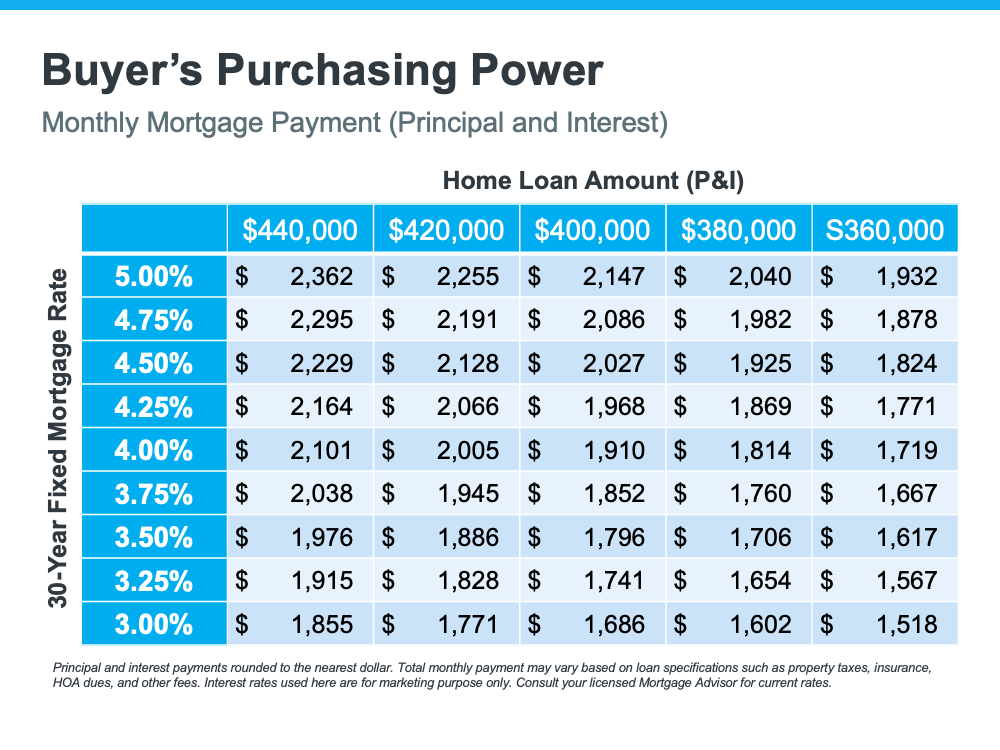
Mortgage rates have increased significantly since the beginning of the year. Each Thursday, Freddie Mac releases its Primary Mortgage Market Survey. According to the latest survey, the average 30-year fixed-rate mortgage has risen from 3.22% at the start of the year to 3.55% as of last week. This is important to note because any increase in mortgage rates changes what a purchaser can afford. To give you an idea of how rising mortgage rates impact your purchasing power, see the table below:
How Can You Know Where Mortgage Rates Are Headed?
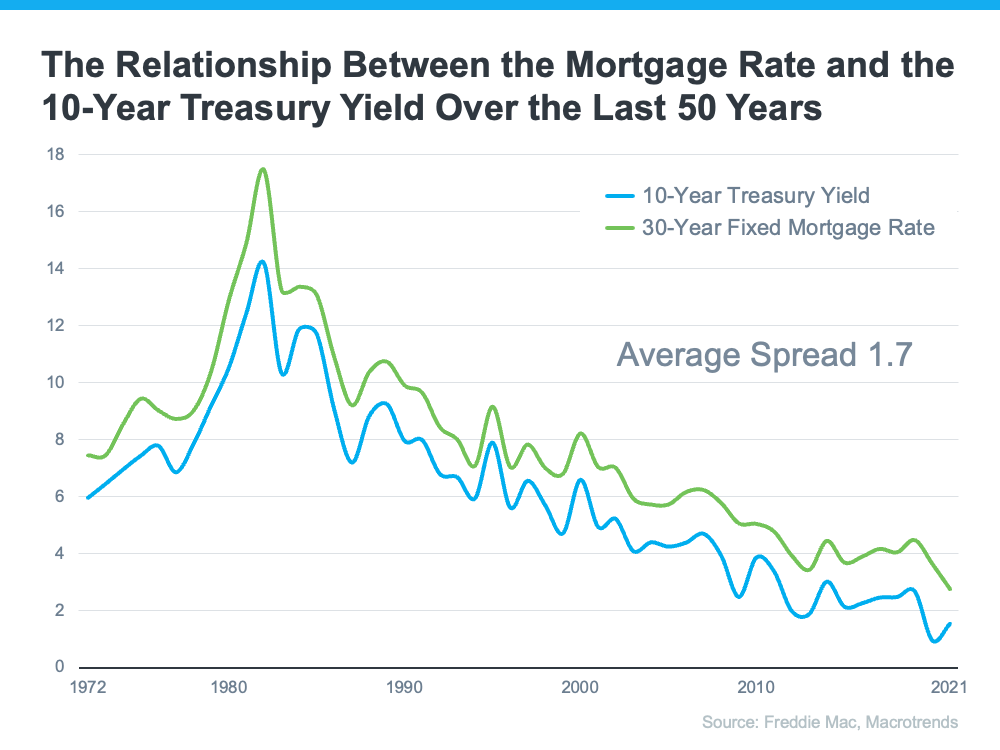
While it’s always difficult to know exactly where mortgage rates will go, a great indicator of where they may head is by looking at the 50-year history of the 10-year treasury yield, and then following its path. Understanding the mechanics of the treasury yield isn’t as important as knowing that there’s a correlation between how it moves and how mortgage rates follow. Here’s a graph showing that relationship over the last 50 years:
This correlation has continued into the new year. Pretty remarkably similar, huh? The treasury yield has started to climb, and that’s driven rates up. As of last Thursday, the treasury yield was 1.81%. That’s 1.74% below the mortgage rate reported the same day (3.55%) and is very close to the average spread we see between the two numbers (average spread is 1.7).
Where Will the Treasury Yield Head in the Future?
With this information in mind, a 10-year treasury-yield forecast would be a good indicator of where mortgage rates may be headed. The Wall Street Journal just surveyed a panel of over 75 academic, business, and financial economists asking them to forecast the treasury yield over the next few years. The consensus was that experts project the treasury yield will climb to 2.84% by the end of 2024. Based on the 50-year history of following this yield, that would likely put mortgage rates at about 4.5% in three years.
While the correlation between the 30-year fixed mortgage rate and the 10-year treasury yield is clear in the data shown above for the past 50 years, it shouldn’t be used as an exact indicator. They’re both hard to forecast, especially in this unprecedented economic time driven by a global pandemic. Yet understanding the relationship can help you get an idea of where rates may be going. It appears, based on the information we have now, that mortgage rates will continue to rise over the next few years. If that’s the case, your best bet may be to purchase a home sooner rather than later, if you’re able.
Bottom Line
Forecasting mortgage rates is very difficult. As Mark Fleming, Chief Economist at First American, once said:
“You know, the fallacy of economic forecasting is don’t ever try and forecast interest rates and or, more specifically, if you’re a real estate economist mortgage rates, because you will always invariably be wrong.”
However, if you’re either a first-time homebuyer or a current homeowner thinking of moving into a home that better fits your changing needs, understanding what’s happening with the 10-year treasury yield and mortgage rates can help you make an informed decision on the timing of your purchase. Give us a call at Braceland Homes 619-947-3560 to discuss if and when the time is right for you to buy a home.






![The Difference Between Renting and Owning [INFOGRAPHIC] | MyKCM](https://files.mykcm.com/2022/02/24130106/20220225-MEM-1046x2279.png)